 ICENI MICROSCOPY STUDY GROUP
ICENI MICROSCOPY STUDY GROUP
Slide Making
Overview, Slides, Cleaning slides, Cover Slips, Centering specimen, Slide Warming, Ringing table, Brushes, Slide Labels, Gum for Labels.
Overview. Preparations may be temporary or permanent. The main types are dry, fluid or resin mounts.
The preparation of material for resin mounting (the most complicated) involves: Killing, Fixing, (Staining), Dehydrating, Clearing and Mounting.
For mounting pollens in glycerine jelly:
1. Kill, Fix (and remove the outer coating of oil) in iso-propyl alcohol.
2. Stain with Safranin.
3. Rinse (and dehydrate) in absolute alcohol.
4. Clear in glycerine and water.
5. Mount in glycerine.
Next, to prevent deterioration of the preparation, seal the edges around the cover slip using some form of cement. This is best done by ‘ringing’ using a ringing table - but this is not essential.
Finally, the slide should be labelled.
Slides. While different companies offer a range of slides of differing quality, for most microscopy work the cheaper varieties are good enough.
Cleaning. Slides and cover slips often come from the manufacturer with dust, grease and small glass shards so need washing before use. This is best done using an old toothbrush dipped first into a standard cleaning fluid (50/50 methylated / water mixed with a small dash of washing-up liquid), then with scouring powder or ‘Jif’. Finish by wiping with a soft cloth (clean old handkerchief) until dry and free of abrasive, polish with chamois leather and put back into their vacuumed box ready for use.
For specimens whose depth exceeds that of the mountant, slides with a cavity or a ring are needed; match ring and cover slip diameters. Other ways of providing depth include a trio of tiny slips of paper or plastic, or a narrow ring of gold size or a resin mountant may be built up, layer by layer.
Cover slips can be bought in a variety of diameters or, more cheaply, square or oblong. For appearance, circular, ringed, slides ‘fit’ the microscope’s view so often look best but require a circular cover glass. Suppliers offer them in various diameters from 9 to 19 mm. Discs can be cut from squares using a glass cutter. Ideally, the size of the subject should be suited to the size of the cover slip; pollen grains are small and are viewed at a high magnification with a small field of view so small cover slips are best.
Coverslip number |
Coverslip thickness (mm) |
#0 |
0.08 - 0.12 |
#1 |
0.13 - 0.17 |
#1.5 |
0.16 - 0.19 |
#2 |
0.17 - 0.25 |
Cover slip thickness. Most objectives are designed for a cover slip thickness of 0.17 mm. Use of a cover slip of the wrong thickness can introduce spherical aberration or physically obstruct a high power lens being correctly focussed. From the list below it might seem that #1.5 gives the best fit but this is only true when the sample is on the cover slip. Most cover slips in a batch of #1.5 are still not optimal (= 0.17 mm) and, depending on the manufacturer, often a few percent of cover slips in a box are outside the range of 0.16-0.19. Also, when the sample is on the slide, there may be a relatively thick layer of mountant between the sample and the cover slip so standardisation on #1 is recommended.
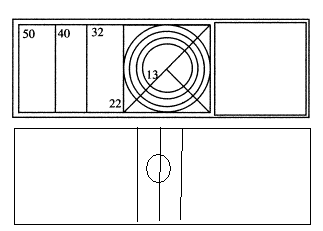
Ensuring the specimen is central and upright. The best slide makers ensure their specimens are precisely in the centres of their slides and upright. One way is to use a mounting guide (see over the page). A better way is to follow Peter Sunderland and, as the final part of preparing slides for use, use a template and a fine marker to draw on the back of each slide, first a small circle then, using the edge of another slide, three vertical lines. To avoid mounting the specimen on top of these marks, use the same pen to mark the upper side ‘TOP’. After mounting, these marks are wiped away.


Slide Warming Plate. Some heat is usually needed either to liquefy glycerine jelly or to dry Canada Balsam (or a modern substitute for it). While warming plates can be bought, they are expensive. It is not difficult to make your own. Suggestions for such a box appear as page 4.
Once the specimen is on the slide, the edge of the cover slip must be sealed. With glycerine jelly, this should be done within a day or two to prevent moisture from the air seeping in and damaging the work. Gold size is a good initial sealant since it acts as a barrier, preventing any reaction between the mountant and whatever decorative finish which may be applied later. Trials by David Galiford have shown that the cheapest brand, Hanover (1-2 hours), works well; this was also the quickest drying of those tested. Other choices for initial sealants are french polish or carpenter’s knotting. Resin mountants (such as Canada Balsam, Numount or Practamount) need no initial sealant but may take 6 weeks to dry.
Ringing table. To apply sealant to a circular cover slip, a ringing table is needed. This is a small book sized block which carries a free spinning disc; the disc is fitted with two light clips to hold a slide. Try before you buy because some on the market do not spin as freely as they ought.
Until sealed, slides should be kept horizontal; a ‘wallet’ holder is best for this. Once sealed, slides may be kept on edge in a slide storage box.
Before final ringing, re-clean as for a new slide.
Brushes. Cheap paint brushes have parallel bristles. In good ones made with animal hairs such as sable, squirrel or pig, bristles taper towards the tip. Technically such tapered bristles are described as ‘dog’s cock’. Brushes should be cylindrical. A recommended make of such artists’ brushes is ‘Rosemary’. Size varies with make but #2 is about right. It is a mistake to use too small a brush.
Rosemary & Co. Ltd. supply very good brushes, a Red Sable Blend is recommended with a round pointed end. Suitable brush sizes are catalogue no. 401SH/2-0 for the application of black and 401SH/3-0 for colours.
A catalogue or brushes may be obtained via e-mail at rosemary@rosemaryandco.com or by telephoning 01535 600090. There is also a web site www.rosemaryandco.com
When slides are clean and dry, decorative rings of enamel paint may be applied. Small pots of Humbrol enamel are available from hardware, toy and model shops [or via www.humbrol.com or by telephoning 01843 233525] for just over £1 a pot. As soon as a pot of paint is opened, it begins to lose its volatile dryers so its consistency will change; in other words, it does not keep. Since these small pots are so cheap, it is better to buy another than continue too long with an old one. Old craftsmen used to reduce the loss of volatile constituents by replacing the volume of paint used with ball bearings..
Peter Sunderland of the Iceni Microscopy Group recommends using cellulose thinners with Humbrol, not their own brand thinner, and a different brush and jar of thinner for each colour, both carefully kept only for that colour. He keeps a block with cut-outs so that each paint can be kept next to its thinner. Just before use, stir the paint with a match or cocktail stick.
Put the slide onto the ringing table; ensure it is central and secure it with the clips. For right handed people, spin anticlockwise to check the slide is placed correctly; adjust if not. Begin by priming the area to be painted; priming ensures the paint does not spread further than wanted. Load the brush with thinner and, holding it almost vertically but with the top slightly inclined away, apply it with just a little pressure onto the right hand side of the spinning cover-slip; the idea is that the liquid should be drawn off the tips of the brush's bristles - so barely half the bristles should be in contact with the glass, just enough to define the edges neatly.
It is suggested that as a base paint, a black ring should be applied first. Load the brush by dipping it again into solvent and then the tips only of the bristles into paint. Apply a ring as above, approximately 4 to 5 mm wide, the smaller measurement for small cover slips, wider for larger; the thinner the paint, the better its adhesion to the glass. Apply the first ring with confidence and


enough pressure to form a neat ring with precise edges (Diagram 1). When established, any more paint added will not bleed outside the ring; second and third coats can be added immediately. When the table is spinning, hardly any pressure at all is needed to pull off the paint into a high build. The longer the brush is kept in contact, the more paint will be pulled off the brush (Diagram 2). The appearance can be enhanced by putting on, say, three coats one after another in one go, and then letting it dry. 24 hours drying time must be allowed before adding any more paint for a final finish. When dry, the paint should have a convex meniscus. First coats should always be slightly thinned to assist in sticking to the paint already there. To give the paint a really good gloss, a final well thinned layer can be applied.
Additional rings can be added later, even months later if you wish. While there is no particular convention, some like to ring with a colour to indicate the slide’s contents; e.g. green: plant origin, red: body parts and orange: disease.
JDQ with advice from PS and LW, August 2011.
Diagram 1
Computers allow small clear lettering to be printed so are ideal for labels. Water based inks may 'run' during cleaning-up processes. Some waterproof their labels with the lacquer used to coat polished brass or even hairspray!
Gums for labels.
1. A simple practical way is to use PVA wood glue, mixed 50:50 with water. This is painted onto the slide and, after a short period of time, the label is lowered on using tweezers. After a further short period, a matter of seconds, the paper bites onto the glue - then very carefully go around the perimeter with a damp paint brush to remove any excess.
2. The traditional recipe is:
Process |
Ingredient |
Full Quantity |
1/20th of quantity |
Solution 1. |
Gum Tragacanth |
30 g |
1.5 g |
Water |
250 ml |
12.5 ml |
|
Stand for some hours. Shake until the liquid froths and then mix with: |
|||
Solution 2. |
Gum Arabic |
120 g |
6 g |
Water |
250 ml |
12.5 ml |
|
Strain the mixture through linen and add to: |
|||
Mixture 3. |
Glycerine |
150 g |
7.5 g |
Oil of cloves |
2.5 g |
0.125 g |
|
Notes:
1. This looks complicated but the resulting paste is good; it is actually quite easy to make up.
2. I made up a suitable amount for my use by dividing each of the quantities quoted above by 20. A small digital balance can be used to weigh small quantities – these are obtainable from Maplins and others for less than £20.
3. In mixture 3, there are plenty of alternatives to Oil of cloves. In "On Mounting Microscopic Objects", Davis writes that we need "a small quantity of an essential oil [to prevent the growth of mould]. One fourth of its [the solution's] volume of alcohol would serve the same purpose".
4. The gums required can be obtained from a retailer of artists' materials and the essential oil from a high street pharmacy.
5. While some might decide that it is better to purchase a proprietary paper paste, I suspect that others like me will find the use of a traditional - and proven - recipe an attractive proposition. My original batch of this glue has not yet "run out", after several years, so I recommend making up a relatively small quantity.
LW., Nov., 2008
This is based on John Hunt’s suggestion.
# |
Item |
Stock Number |
Comment |
1 |
Aluminium alloy box |
Maplin N71FK |
125 x 125 x 75mm made by Eddystone. (Or better from Rapid: 188 x 120 x 78mm). |
2 |
Lamp oven 40w E14 screw |
Maplin N13BR |
Domestic incandescent lamps are being phased out but oven lamps should continue. |
3 |
Lamp holder E14 |
|
Maplin don’t stock ceramic this size; Bakelite possible as temperature not high. |
4 |
Controller |
Maplin L57BC |
Lighting dimmer. |
5 |
Input socket: 3 pin Euro Plug |
Maplin 6HL15 |
Three pin as the box must be earthed. |
6 |
Power lead: IEC Connector |
Maplin 4MK41 |
My first purchase gave a poor connection. |
7 |
Wiring |
|
Domestic house wiring cable, single core. |
8 |
Base cover |
|
Thin plywood with 1” x 4 ventilation holes; allow corner space for feet. |
9 |
Feet |
|
To raise the box for airflow and keep the warm box off the table. |
10 |
Small bolts and nuts to secure fittings in place x 6 |
Three small washers help secure the connecting wires. |
|
Once warm, even when the controller is turned down to its minimum, the 40w lamp still keeps the glycerine jelly liquid, ie the temperature is above 35°C; a 25w lamp might be enough for the job. I tried an aquarium thermometer but its range is not high enough.
Alternative sources of supply: Rapid Electronics, Easy Control Gear or RS.
The box comes with a lid; discard this but keep the securing screws for holding the ply base cover in place. The outside of the base of the box becomes the top of the warming plate. A hole is cut in the far left corner for a small jar of glycerine jelly; this jar is supported on a small aluminium right-angled bracket; its securing screw also served as an anchorage point for the earth wire.
Other holes are cut:
1. Centrally in the front for the controller – the top edge of the controller should be level with the top of the box. The lower side will be below the box bottom edge but the box feet will raise the box enough for this to clear the table.
2. In the back bottom left hand corner for the input socket (when looking at it from the back).
I fixed the lamp holder to the right hand side but think it might be better secured to the back so that the fixing screws cannot catch a stray hand.
For safety, ensure no stray finger can enter the box; guard any hole large enough with mesh.
Jeremy Quinlan November 2010